Understanding teeth whitening treatment
If you are thinking about teeth whitening treatment, you are probably looking for a brighter, more confident smile without making your teeth look fake or overdone. Teeth whitening is one of the most requested cosmetic dentistry services, and when it is planned correctly, it can be a safe and predictable way to enhance your smile.
Most whitening approaches work in one of two ways. They either chemically lighten stains using bleaching agents like hydrogen peroxide or carbamide peroxide, or they physically polish away surface discoloration with mild abrasives, as you see in many whitening toothpastes [1]. Understanding how each method works helps you choose the option that matches your goals, sensitivity level, and budget.
At Rox Dental Studio, whitening is often the first step in a larger cosmetic smile makeover. Aligning tooth color before you consider veneers, bonding, or gum contouring makes it easier to design a smile that looks balanced and natural.
How teeth whitening works
Teeth whitening treatment targets stains in and on your enamel. These stains are caused by compounds called chromogens that cling to or soak into your teeth over time. Whitening gels break apart these chromogens so that light reflects differently off your enamel and your teeth appear whiter [1].
Bleaching vs stain removal
You will usually encounter two basic approaches:
- Bleaching with peroxide
Most professional and at‑home whitening products use hydrogen peroxide or carbamide peroxide as the active ingredient to change the intrinsic color of the tooth. These molecules penetrate enamel and oxidize stain compounds within the tooth structure [2]. When used as directed, peroxide‑based whitening is considered safe and effective, although temporary sensitivity and gum irritation are common [3]. - Mechanical stain removal
Whitening toothpaste and some polishes rely on mild abrasives, such as baking soda, to gently sand away surface stains each time you brush [1]. These formulas do not change the underlying color of your teeth. Instead they make your natural shade look cleaner and brighter by removing coffee, tea, tobacco, or food pigments from the outer surface.
Many patients use a combination of both, professional bleaching to significantly lighten their teeth and whitening toothpaste to maintain results.
Intrinsic vs extrinsic stains
Whitening results depend on the type of staining you have [4]:
- Extrinsic stains
These sit on the surface of your enamel and are usually linked to coffee, tea, red wine, food colorings, and smoking. Extrinsic stains typically respond very well to whitening treatments and polishing. - Intrinsic stains
These occur inside the tooth, often due to antibiotic use in childhood, high fluoride exposure, trauma, enamel thinning with age, or genetics [4]. Intrinsic stains can be more stubborn. You may still see improvement, but sometimes you need additional options such as veneers for front teeth or dental bonding service to fully disguise deep discoloration.
During a cosmetic dental evaluation, your dentist will examine the types of stains present so you know what level of whitening is realistic for your smile.
Professional vs at‑home whitening options
You have a wide range of choices, from one‑visit in‑office whitening to over‑the‑counter strips in the drugstore. All have their place. The best option for you depends on how fast you want results, how much shade change you are looking for, and your tolerance for cost and sensitivity.
In‑office professional whitening
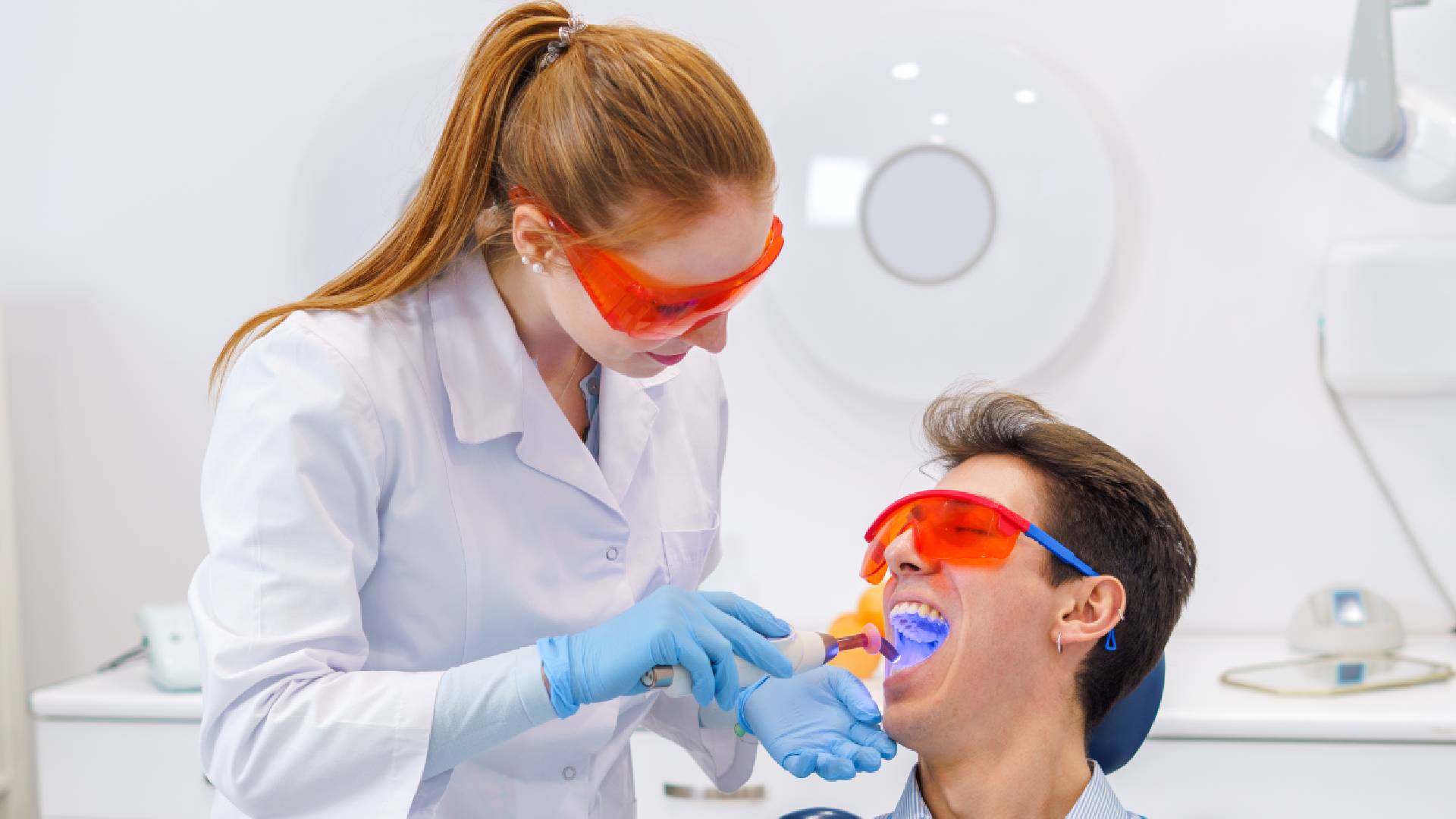
In‑office whitening is performed at a cosmetic dental clinic using a high‑concentration peroxide gel. Your gums are carefully protected, the gel is applied to your teeth in controlled cycles, and some systems use an LED light to activate the gel.
Clinical evidence suggests that high‑concentration hydrogen peroxide can reliably lighten teeth, but it also frequently causes temporary sensitivity [3]. Studies have found that adding light activation does not consistently improve whitening, does not extend color stability over three months, and may increase the risk of sensitivity in some cases [3].
According to Aspen Dental, in‑office whitening can brighten teeth by up to about 10 shades in a single session and usually lasts from six months to one year, depending on your diet and habits [5]. Professional treatments tend to cost more than at‑home kits, but they offer faster, more dramatic results and close monitoring by your dentist.
In many smile projects at Rox Dental Studio, in‑office whitening is used first, then fine‑tuned with at‑home trays or paired with a whitening + veneers package for a more comprehensive transformation.
Dentist‑supervised at‑home trays
Custom take‑home trays from your dentist use lower‑concentration carbamide or hydrogen peroxide gels in a form‑fitting mouthpiece. You typically wear these a set number of hours per day or overnight for one to two weeks.
The American Dental Association notes that at‑home bleaching with custom trays is a common, effective professional method and can be worn comfortably while you are awake or sleeping [2]. Many people see their first changes in a few days, with most of the whitening visible by two weeks of consistent use [1].
This route is popular if you want:
- More control over the pace of whitening
- The ability to pause if your teeth feel sensitive
- An affordable way to maintain the results of in‑office whitening
Over‑the‑counter whitening products
You will find strips, paint‑on gels, LED kits, toothpaste, and rinses in stores and online. These typically use:
- Lower concentrations of carbamide or hydrogen peroxide
- Mild abrasives such as baking soda or charcoal in toothpastes
- Stain‑suspending agents in rinses [4]
According to the Cleveland Clinic, strips or gels can give you noticeable improvements within about two weeks, while whitening toothpastes and rinses work more slowly and gently [1]. The ADA warns that overusing abrasives or peroxide can damage enamel, which does not repair itself, so it is important to stick closely to product directions and avoid stacking multiple whitening products at the same time [4].
When you are shopping on your own, look for the American Dental Association (ADA) Seal of Acceptance, which indicates that the product has been evaluated for safety and effectiveness [1].
Safety and side effects of whitening
Teeth whitening treatment has been used by millions of people over several decades. Large reviews report no increase in cavity risk or tooth fractures associated with properly used whitening products, which is reassuring if you are worried about long‑term harm [1]. That said, no cosmetic procedure is completely free of risks.
Common, typically temporary effects
You are most likely to notice:
- Tooth sensitivity
Whitening can make your teeth feel sensitive to cold, air, or sweet foods. This is especially true with strong in‑office gels and higher concentrations of hydrogen peroxide [3]. Sensitivity usually peaks in the first 24 to 48 hours and gradually returns to normal as the enamel rehydrates. - Gum irritation
If the gel touches soft tissues, it can cause short‑term irritation or a burning sensation. Dentist‑applied barriers and well‑fitting trays significantly reduce this risk, and any irritation typically resolves quickly once the gel is removed [1].
Using sensitivity toothpaste before and after whitening and spacing out whitening sessions can help you stay comfortable. During a cosmetic dental care visit, your dentist can also recommend professional desensitizing treatments if you have a history of sensitivity.
Less common but important concerns
Research has shown that very aggressive bleaching with high‑concentration in‑office products may cause:
- Temporary enamel softening
- Increased surface roughness
- Greater susceptibility to demineralization in laboratory settings [3]
While these effects have mainly been observed in controlled in vitro studies, they underscore why bleaching should always follow manufacturer instructions and be supervised by a dental professional when stronger products are used.
Restorative materials can also be affected. Studies note that composite resins and glass ionomer cements may soften or undergo color change when exposed to strong bleaching agents [3]. If you already have fillings, crowns, or veneers in your front teeth, it is especially important to plan whitening around those restorations.
Who is a good candidate for whitening
Not every smile responds to teeth whitening in the same way. Before you begin, your dentist should complete a thorough exam to make sure whitening is safe and to customize a plan for you.
You are generally a good candidate if:
- Your front teeth are mostly natural enamel without extensive restorations
- You have extrinsic or mild intrinsic staining
- Your gums are healthy and free from active periodontal disease
- You understand that whitening can improve brightness, but not change tooth shape or alignment
You may need to delay or modify whitening if you have:
- Untreated cavities or fractures
- Active gum disease or significant recession
- Very worn or thin enamel
- A history of severe sensitivity
Whitening is typically not recommended for children under 16, pregnant individuals, people with allergies to whitening ingredients, or those with extensive existing restorations in visible areas, all of which are considerations highlighted in professional protocols [5].
If your dentist determines that whitening alone will not meet your goals, you might discuss complementary options, such as porcelain veneer placement or a combined smile design consultation to explore a more comprehensive plan.
In many cases, whitening is the first step, not the final solution, especially if you are planning a broader smile transformation.
Whitening and existing dental work
One key limitation of teeth whitening treatment is that peroxide does not lighten porcelain or composite materials. That means dental crowns, veneers, tooth‑colored fillings, and bonding will not change color, even if your natural enamel becomes several shades lighter [2].
This matters for two reasons:
- Color mismatch
If you whiten teeth that sit next to older restorations, the natural teeth may end up lighter, which can make existing dental work stand out. - Treatment sequencing
If you are planning new cosmetic work, it is usually smart to whiten first, allow the final shade to stabilize, then match any new veneers & bonding dentist work to your lighter color.
At Rox Dental Studio, whitening is often integrated into a larger smile transformation dentist plan. For example, your dentist may:
- Whiten your full smile arch
- Reevaluate after a couple of weeks to confirm the final shade
- Replace or adjust visible fillings and bonding as needed
- Use whitening as a foundation for a whitening + veneers package if you are also addressing worn or misshapen teeth
This sequencing helps you avoid uneven color and reduces the need to replace restorations again in the near future.
Alternatives when whitening is not enough
If your teeth do not respond well to bleaching or you have structural issues in addition to discoloration, you still have several cosmetic options.
Porcelain veneers
Porcelain veneers are thin ceramic shells that bond to the front of your teeth. They can mask severe discoloration, enamel defects, spacing, and minor crowding all at once. With careful porcelain veneer placement, your dentist can select a shade that looks bright but still believable, then customize the shape and translucency to flatter your face.
Veneers are ideal if:
- You have deep intrinsic stains that do not respond to whitening
- You want to correct chips, small gaps, and irregular shapes at the same time
- You are looking for a dramatic change within a relatively short treatment window
Cosmetic bonding
If your discoloration or shape issues are localized to a few teeth, dental bonding service may be a conservative alternative. With bonding, your dentist applies tooth‑colored resin to specific areas to cover stains, close small gaps, or improve proportion.
Bonding is usually more budget friendly than porcelain and often involves little or no removal of enamel. It pairs well with whitening, particularly when you want a full‑smile brightness boost plus selective refinement of a few front teeth.
Gum contouring and smile framing
Sometimes your tooth color is only part of the picture. Excess gum display, uneven gumlines, or short‑looking teeth can make even very white teeth look less attractive. A gum contouring cosmetic dentist can gently reshape the gum tissue around your front teeth to create a more harmonious frame.
Combining gum contouring with whitening is a powerful way to make your smile look more proportional and youthful without extensive restorative work. In more comprehensive treatment, these services are often included as part of broader esthetic dentistry services.
Setting expectations and maintaining results
One of the most important parts of any teeth whitening treatment is setting realistic expectations. Whitening can significantly brighten your smile, but it has limits, and results are not permanent.
What you can realistically expect
Most people will see their teeth lighten by a few shades with at‑home products and more with supervised professional treatment [1]. Deep intrinsic stains may lighten but not disappear entirely. Even with excellent results, small variations between teeth are common because each tooth responds slightly differently.
Professional in‑office whitening tends to give you the most noticeable change in the shortest time frame, often with just one or a few sessions [4]. Over‑the‑counter methods are gentler and more gradual, so they require patience and consistent use.
How long whitening lasts
Whitening is not a one‑time, lifetime procedure. The length of time your results last depends largely on your habits. Aspen Dental notes that professional in‑office whitening typically lasts six months to one year, while at‑home options may last a few months [5]. Frequent coffee, tea, red wine, or tobacco use can shorten that interval significantly.
You can prolong your results by:
- Limiting highly pigmented foods and beverages, or rinsing after you consume them
- Not smoking or vaping
- Keeping up with regular professional cleanings
- Using touch‑up whitening with custom trays as directed by your dentist
Because habits and enamel vary so much, your maintenance plan should be tailored to you during your cosmetic dental evaluation.
Planning your whitening with a cosmetic dentist
If you are considering teeth whitening treatment, working with a cosmetic dentist gives you a clearer roadmap and safer, more predictable outcomes. At a smile design consultation, you can:
- Review your current tooth shade and types of staining
- Discuss your ideal shade and how it fits with your eyes, skin tone, and facial features
- Evaluate any existing restorations that might affect your whitening plan
- Explore how whitening fits into a comprehensive cosmetic dental care or cosmetic smile makeover
From there, you and your dentist can decide whether in‑office whitening, custom at‑home trays, or a combination is best, and whether you might eventually benefit from veneers, bonding, gum contouring, or a smile transformation dentist approach.
Teeth whitening can be a simple refresh or the first step in a complete cosmetic plan. When it is done thoughtfully, with your overall smile in mind, it becomes less about chasing the brightest possible shade and more about creating a natural, confident look that feels like you.