Tooth loss is one of the most preventable outcomes in dentistry, yet the CDC reports that nearly 1 in 5 adults over 65 has lost all their teeth. The reason why dental cleanings prevent tooth loss comes down to a simple principle: the damage that leads to losing a tooth builds up slowly, silently, and stops being reversible at a specific point. Regular cleanings interrupt that process before it crosses that line.
What Dental Cleanings Actually Do for Your Teeth
About 26% of American adults have untreated tooth decay, and periodontal disease affects nearly half of adults over 30, according to CDC surveillance data. Neither condition announces itself with pain in the early stages. That silence is the problem. By the time a tooth hurts or a gum bleeds unprompted, the underlying damage has usually been progressing for months or years.
The pattern is predictable: bacterial accumulation leads to gum inflammation, gum inflammation leads to bone loss, and bone loss leads to teeth that no longer have adequate support. Professional cleanings are the one intervention that reliably breaks that chain before it becomes irreversible. Skipping them does not just delay a routine appointment. It lets a compounding problem run uninterrupted.
The Real Causes of Tooth Loss
Periodontal disease and advanced decay account for the overwhelming majority of tooth loss in adults. A 2012 analysis published in the Journal of Dental Research, drawing on NHANES data from over 6,000 adults, found that periodontal disease was the primary driver of tooth loss in adults over 35, responsible for more extractions than trauma or decay alone. The striking part is that most of those patients had no idea the disease was progressing.
Both gum disease and decay follow the same quiet trajectory. You do not feel the bacteria eroding your enamel. You do not feel the inflammation pulling your gum tissue away from the root. Pain enters the picture late, usually when the damage is extensive enough to require serious intervention: a root canal, an extraction, a bridge. Think of it like skipping car inspections for a few years. You might drive fine for a while, but what would have been a simple fix quietly becomes a much bigger repair.
How Plaque and Tartar Start the Process
Plaque is a soft, sticky film of bacteria that forms on teeth every single day. Left undisturbed, it begins mineralizing into tartar (also called calculus) within 24 to 72 hours. A study published in the Journal of Clinical Periodontology found that supragingival calculus formation is detectable in as little as two weeks without professional removal, even in patients with good brushing habits.
The key word is “professional removal.” Once plaque hardens into tartar, no toothbrush or floss removes it. It bonds to the tooth surface and becomes a stable platform for more bacterial growth, especially below the gumline where brushing cannot reach at all. Even diligent daily brushers accumulate tartar in interproximal spaces and along the gumline. That buildup is not a reflection of poor hygiene. It is just biology, and it is exactly what a cleaning is designed to address.
How Gum Disease Progresses to Tooth Loss
Gum disease moves through stages: gingivitis, then periodontitis, then advanced periodontitis with bone involvement. According to the CDC, 47% of adults over 30 have some form of periodontitis, and a significant portion of those cases are undiagnosed. The mechanism behind tooth loss is not the infection pulling teeth out directly. It is the destruction of the alveolar bone and periodontal ligament, the structures that physically anchor teeth in the jaw.
Once bone is lost, it does not regenerate on its own. A tooth that looks structurally intact above the gumline may already be losing its foundation below it. Understanding the stages helps you see what a hygienist is actually evaluating during a cleaning appointment: pocket depths, attachment levels, and bone patterns on X-rays are all early warning signals that show up well before a tooth feels loose.
What Happens During a Professional Cleaning
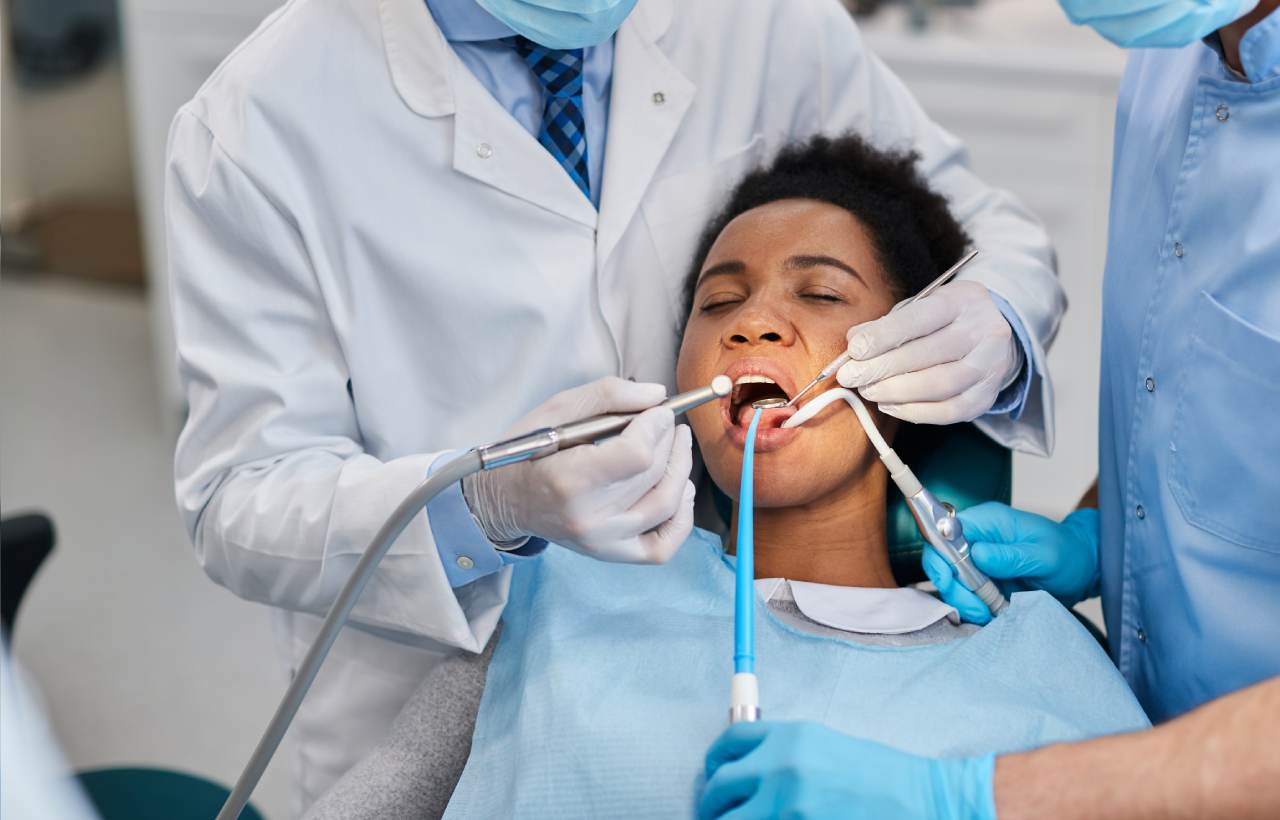
A standard prophylaxis cleaning, the type most patients receive every six months, involves scaling to remove calculus above and just below the gumline, polishing to remove surface stain, and a periodontal assessment that measures pocket depths around each tooth. A 2015 systematic review in Cochrane Database of Systematic Reviews confirmed that professional scaling significantly reduces plaque and bleeding indices, with effects lasting up to six months in patients without active disease.
This is different from a deep cleaning, which is the treatment for patients who already have active periodontal disease. Understanding which type of cleaning you are scheduled for matters because they serve different purposes and address different stages of the disease.
When a Deep Cleaning Is Recommended
A deep cleaning, formally called scaling and root planing, extends below the gumline to remove calculus deposits from the root surfaces and smooth the root to discourage bacterial reattachment. A hygienist recommends it when pocket depth measurements exceed 4mm, when bleeding on probing is consistent, or when bone loss is visible on X-rays.
A 2015 Cochrane review of scaling and root planing found that the treatment produced a statistically significant reduction in pocket depth of about 1mm on average, which is enough to shift many sites from active disease to a manageable, stable state. If a hygienist recommends a deep cleaning and you have not had one, ask to see your pocket depth chart. The numbers are a concrete baseline that shows exactly where the disease stands and why treatment is indicated.
How Cleanings Disrupt the Path to Tooth Loss
A professional cleaning removes the bacterial colonies that brushing cannot reach, cutting off the fuel supply for the inflammatory cycle. A 2014 longitudinal study published in the Journal of Periodontology, following over 5,100 patients across 16 years, found that patients who completed regular preventive cleanings retained significantly more teeth than those who received only episodic treatment. The difference was not marginal. Consistent cleaners lost fewer than half the teeth that sporadic attenders lost over the same period.
The mechanism is direct: scaling removes calculus-bound bacteria before they trigger the bone resorption that makes tooth loss inevitable. The cleaning does not just polish teeth. It removes the infrastructure that drives the disease. Pair that with what you do between dental visits to maintain your teeth, and the compounding effect runs in the opposite direction.
The Role of Early Detection
Every cleaning appointment is also a diagnostic appointment. Pocket measurements, X-rays, and visual exams taken at regular intervals create a running record of what is changing in your mouth. A 2018 study in the Journal of Dental Research found that early intervention at the gingivitis stage cost 62% less in total treatment over five years than waiting until periodontitis was established.
A 3mm pocket caught at a routine visit costs a focused cleaning and adjusted home care. That same site at 6mm, two years later, costs a deep cleaning, possible surgical consultation, and carries a measurable probability of tooth loss. Understanding what your dentist is looking for during a checkup changes how you see the value of the appointment itself.
How Often You Actually Need a Cleaning
The six-month guideline has been the standard recommendation since the 1970s, based on the observed rate at which calculus accumulates in the average adult. But the research on risk stratification tells a more specific story. A 2013 Cochrane review examining cleaning intervals found that high-risk patients, including smokers, diabetics, and those with a history of periodontal disease, show measurably better tooth retention outcomes with three- or four-month recall intervals rather than six.
The six-month rule is a starting point, not a fixed prescription. The interval that protects your teeth depends on how quickly your body accumulates calculus, how your immune system responds to bacterial load, and whether systemic conditions like diabetes increase your susceptibility to bone loss. At your next visit, ask directly whether your risk profile supports a different schedule. That single conversation can change the trajectory of your long-term dental health significantly. For a more detailed breakdown of how to think about frequency, the real answer on how often to see a dentist is worth understanding before your next appointment.
What Cleanings Cannot Do on Their Own
A cleaning removes what has already accumulated. It does not prevent plaque from forming tomorrow. That is your job. A 2016 study in the Journal of Clinical Periodontology found that patients who combined consistent professional cleanings with effective daily plaque removal retained 40% more teeth over 12 years than patients who relied on professional care alone.
Daily brushing and flossing remove plaque in the 24 to 72 hours before it mineralizes. Cleanings remove what escapes that window. Neither replaces the other. The most effective approach pairs the two, which is why patient education is a core part of every cleaning appointment, not an add-on. Ask about technique, not just frequency. An electric toothbrush used correctly outperforms a manual one used poorly, and a water flosser used consistently outperforms floss used occasionally.
Book Before It Becomes Urgent
Check when your last cleaning was scheduled. If it has been longer than six months, book an appointment before the week is out. That one step starts the chain: calculus is removed, pockets are measured, problems at the reversible stage are caught, and the compounding process resets.
The research on this is consistent across decades and study populations. Patients who keep regular cleaning schedules retain more teeth, spend less on restorative treatment, and avoid the downstream costs of extractions and replacements. The cleaning itself is not dramatic. The results of skipping it are. Scheduling a professional cleaning is the most evidence-backed preventive step available, and it is the foundation that preventive dental care is built on.
Frequently Asked Questions
How does a dental cleaning actually prevent tooth loss?
A professional cleaning removes calculus from areas that brushing cannot reach, especially below the gumline. Calculus harbors the bacteria that trigger gum inflammation and, eventually, bone loss. By removing it regularly, cleanings interrupt the process that would otherwise erode the bone and connective tissue holding your teeth in place.
Can tooth loss happen even if your teeth do not hurt?
Yes. Periodontal disease destroys bone silently. Most patients with moderate bone loss have no pain until the disease is advanced. By the time a tooth feels loose or an infection becomes obvious, significant irreversible damage has already occurred. Regular cleanings catch the warning signs before pain appears.
Is a deep cleaning the same as a regular cleaning?
No. A standard prophylaxis cleaning maintains healthy teeth and gums by removing surface and near-gumline deposits. A deep cleaning (scaling and root planing) is a treatment for active periodontal disease, targeting calculus on root surfaces below the gumline. Your pocket depth measurements determine which one is appropriate.
What if you have not been to the dentist in several years?
Starting is still worth it. The damage that has already occurred cannot be reversed, but cleanings and treatment stop further progression. Many patients who return after a long gap find that their condition is manageable with consistent care going forward. The longer you wait, the fewer options are available, so sooner is always better than later.
Does dental insurance typically cover cleanings?
Most PPO plans cover two prophylaxis cleanings per year at 100%, with no out-of-pocket cost. Medicaid plans in North Carolina also cover preventive cleanings for eligible adults and children. Coverage for deep cleanings varies by plan and typically requires documentation of pocket depth measurements. Confirming your coverage before your appointment avoids surprises.
How long does a standard cleaning take?
A routine prophylaxis cleaning takes between 45 minutes and one hour for most adults. If you have not been seen recently or have significant buildup, the appointment may run longer. A deep cleaning is usually split into two appointments, treating one side of the mouth at a time, and each visit typically takes about 60 to 90 minutes.