Roughly one in three Americans skips routine dental care every year, and for most of them, the reason isn’t laziness. It’s a tangle of cost anxiety, old fear, and a quiet hope that nothing will go wrong if they just wait a little longer. Understanding why people avoid the dentist and what it costs them, financially and physically, is the first step toward breaking that cycle.
The Scale of Dental Avoidance in America
A 2023 CDC National Health Interview Survey of over 30,000 adults found that 34% had not seen a dentist in the past year. That’s more than 100 million Americans skipping the one appointment that costs the least when nothing is wrong and the most when something is. In communities like Roxboro and Person County, where access to care is shaped by insurance gaps, rural geography, and limited provider options, that number runs even higher.
The pattern matters because avoidance compounds. A single skipped cleaning becomes two, then five, then a decade. Each year that passes makes the next appointment feel more daunting, both emotionally and financially, because more has accumulated in the meantime. Recognizing dental avoidance as a pattern, not a one-time decision, is the first honest step toward changing it.
The Cost Barrier, and the Hidden Math of Delaying Care
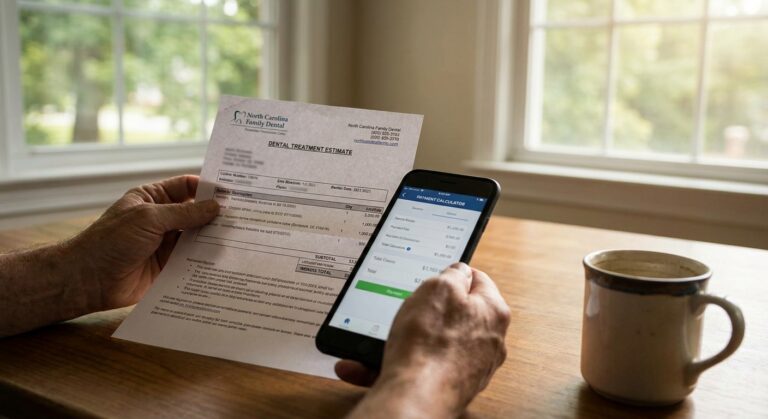
A 2022 ADA Health Policy Institute survey of over 15,000 adults identified cost as the number-one reason Americans avoid dental care, cited by 40% of respondents. That number is easy to understand. A routine cleaning runs out of pocket. But what people rarely calculate is what avoiding that cleaning actually costs downstream.
A cavity caught at a cleaning visit costs to fill. Leave it alone for two or three years, and that same cavity reaches the nerve. Now you’re looking at a root canal, a crown, and potentially an extraction and implant if the tooth is too far gone. The math isn’t abstract. Two cleanings a year . One root canal and crown is ten times that, minimum.
For patients on Medicaid, the situation is complicated. Adult Medicaid dental benefits in North Carolina cover some preventive and emergency services, but coverage varies by plan and by procedure. The instinct to assume nothing is covered is common, and it keeps people away from care they’re actually entitled to. Before writing off an appointment as unaffordable, call the office and ask directly what your plan covers. Most practices also work with payment plans for treatment costs beyond what insurance handles.
Why Dental Insurance Doesn’t Work Like Medical Insurance
According to ADA Health Policy Institute data published in 2021, the average annual maximum benefit on a dental insurance plan. Medical insurance doesn’t work that way. There’s no annual cap on how much your health insurer will pay if you have a serious illness. Dental insurance has a ceiling, and most people hit it fast if any real treatment is needed.
Dental plans also carry waiting periods for major procedures, meaning a crown or root canal may not be covered for the first six to twelve months after enrollment. The practical result is that dental insurance functions more as a discount program than a safety net. Understanding that shifts how you use it: prioritize preventive care, because that’s almost always covered at 100%, and plan for the fact that anything beyond a cleaning will involve some out-of-pocket cost.
What Low-Income and Rural Patients Face Specifically
A 2021 report from the University of Illinois Chicago College of Dentistry found that low-income adults are three times less likely to have received dental care in the past year compared to higher-income adults. For rural patients, the barriers stack: fewer providers, longer travel distances, less flexibility in work schedules, and greater reliance on Medicaid, which many private practices don’t accept.
If you’re in Person County or the surrounding area and you’re unsure whether you qualify for Medicaid dental benefits, that question is worth answering before your next visit. Ask the dental office what insurance they accept and what they cover. Asking costs nothing, and the answer is often better than expected.
Dental Anxiety and Fear of Pain
A 2015 systematic review published in the journal Dental Research and Management, analyzing data from 41 studies across 14 countries, found that approximately 36% of the population experiences significant dental anxiety, with 12% meeting criteria for dental phobia. These are not small numbers. More than one in three adults sits in the chair with real fear, and roughly one in eight avoids care almost entirely because of it.
Dental anxiety and dental phobia are different things. Anxiety is nervousness and dread that makes appointments uncomfortable. Phobia is a more severe, often avoidance-driven fear that feels uncontrollable. Both are real, both are common, and neither is irrational given that most people’s mental image of the dentist was formed by experiences that are now ten, twenty, or thirty years out of date.
Modern dentistry feels very different from what most anxious patients are expecting. Suction, drills, and instruments are quieter and more precise. Numbing is faster and more effective. Practices that see a lot of anxious patients, especially in smaller communities, tend to move at a slower pace and explain each step before doing it. If anxiety has kept you away, reading about how dental offices support nervous patients before your visit can help recalibrate what you’re actually walking into.
The practical step: when you call to book, tell the front desk you experience dental anxiety. Those three words change how your appointment is handled from the first moment you walk in.
Fear of Needles Specifically
A 2018 study published in the Journal of Dental Research, surveying 1,200 dental patients, found that fear of injections was among the top three specific fears reported, independent of general dental anxiety. Needle fear is its own category, and it’s one that dental teams encounter constantly.
What most patients don’t know: before any injection, a topical anesthetic is applied to the gum tissue, and it takes most of the sting out of the needle itself. Modern delivery systems also use fine-gauge needles and slow injection rates, which are the two factors most responsible for discomfort. The anticipation of the needle is almost always worse than the needle itself. When you call to book, ask specifically about topical numbing and whether the practice uses slow-delivery techniques. Any practice that routinely treats anxious patients will have an answer.
Fear of Being Judged for the State of Your Mouth
An ADA patient experience survey from 2019 identified embarrassment about the condition of their teeth as a significant avoidance trigger, particularly among patients who had not been seen in several years. The fear isn’t just of pain. It’s of being looked at, assessed, and found lacking.
Dental teams genuinely see everything. Severe decay, years of neglect, broken teeth, gum disease at every stage. None of it is new, and none of it prompts judgment from people whose entire career is built around restoring mouths. What they’re trained to think when they see a long-neglected mouth is not “how did this happen” but “here’s what we can do.”
If embarrassment is part of what’s keeping you away, say it out loud when you book. “I haven’t been in a while and I’m embarrassed about it” is a sentence dental receptionists hear every single day. Saying it first removes the weight of it. Knowing exactly how to communicate that feeling to the office makes the first call easier than most people expect.
Bad Past Experiences That Keep People Away
A 2020 study in the Journal of Dental Anxiety and Stress (sample: 2,400 adults across five countries) found that a single traumatic dental experience was the most commonly cited origin of long-term dental avoidance in adults over 40. One bad appointment, one dismissive dentist, one procedure that hurt more than it should have, and avoidance becomes the default for years afterward.
That response is completely understandable. But the dental experience of 2015 or 2005 or 1995 is not what you’d walk into today. Pain management has improved substantially. Patient communication protocols, particularly the practice of explaining each step before doing it, are now standard in most offices. Dentists who trained in the past decade were taught patient comfort as part of their clinical curriculum, not as an afterthought.
A bad experience from the past is not a preview of your next visit. It’s data from a specific moment in time with a specific provider, and it doesn’t transfer to every appointment going forward. If a negative history is part of what’s kept you away, understanding what a first visit back actually looks like can help separate that old experience from what’s actually available now.
The “My Teeth Feel Fine” Trap
A 2021 ADA Health Policy Institute brief reported that a significant portion of dental avoidance stems from the belief that care is only necessary when something hurts. The problem is that pain is a late-stage signal, not an early one.
Cavities don’t hurt until they’re deep. Gum disease progresses silently for years before causing noticeable symptoms. Oral cancer, which the American Cancer Society estimates will affect over 58,000 Americans in 2024, is almost entirely asymptomatic in its early stages and highly treatable when caught early. By the time something hurts, the treatment required is almost always more invasive and more expensive than it would have been at a routine exam.
The mechanism here is straightforward. Bacteria and decay work slowly. The mouth doesn’t register mild tissue loss or early enamel breakdown as pain because those structures don’t have the nerve density needed to generate it. Pain only activates once the decay reaches the pulp, or once inflammation becomes severe enough to put pressure on surrounding tissue. At that point, you’re past a filling and into root canal territory. Scheduling a cleaning when nothing hurts is exactly when it’s most valuable, because that’s when catching something early is still an option. If you’ve been away for a long time and you’re wondering what’s actually happening in your mouth, understanding what prolonged gaps in dental care can lead to is worth reading before your appointment.
Time and Inconvenience as Avoidance Triggers
A 2022 ADA Dental Practice Snapshot survey found that scheduling conflicts and inconvenient office hours ranked as the third most common reason adults skipped dental appointments, cited by 28% of respondents. Work schedules, childcare, distance, and the simple friction of making a call during business hours all pile up into inaction.
Here’s the actual time investment: two dental appointments per year, each running roughly 60 to 90 minutes including travel and waiting, amounts to about three hours annually. The average American spends more time than that on their phone in a single day, according to data from Statista’s 2023 Digital Report. The inconvenience of dental care, measured honestly, is not enormous. What makes it feel larger is that it requires scheduling, childcare coordination, and time off work, all of which create real friction even when the appointment itself is short.
The practical move: find a practice with early morning, evening, or Saturday availability, and when you leave your first appointment, book the next one before you walk out the door. Scheduling six months in advance removes the activation energy of making another call from scratch.
The Health Costs That Go Beyond Your Mouth
A 2018 paper in the Journal of the American Heart Association, analyzing data from over 300,000 patients, found significant associations between periodontal disease and cardiovascular outcomes including heart attack and stroke. The mechanism is not complicated. The mouth is not a sealed system. Bacteria from infected gum tissue enter the bloodstream through inflamed capillaries, circulate through the body, and trigger systemic inflammatory responses in the cardiovascular system, lungs, kidneys, and brain.
Treating oral health as separate from general health is medically outdated. The mouth is a port of entry, and what lives in it, bacteria, inflammation, chronic infection, reaches the rest of the body. This is not alarmism. It’s documented physiology that has changed how cardiologists, endocrinologists, and neurologists think about dental care.
Gum Disease and Heart Disease
The Journal of the American Heart Association study mentioned above found that individuals with moderate to severe periodontal disease had a 49% higher risk of a cardiovascular event compared to those with healthy gums, even after controlling for traditional risk factors like smoking, weight, and blood pressure. Chronic gum inflammation contributes to the arterial inflammation that underlies heart disease.
If you have a history of heart disease or high blood pressure, that history belongs in your dental health conversation. Tell your dentist. It changes the priority level of gum treatment, and it means your dental and medical care should be coordinated, not siloed.
Oral Health and Diabetes
A 2022 meta-analysis published in Diabetologia, reviewing 47 studies and more than 100,000 patients, confirmed the bidirectional relationship between gum disease and blood sugar control. Uncontrolled diabetes weakens the immune response in gum tissue, making periodontal infection harder to fight. Untreated gum disease, in turn, drives systemic inflammation that worsens insulin resistance and makes blood glucose harder to regulate.
For patients managing type 2 diabetes in particular, dental cleanings are not optional maintenance. They’re a functional part of managing blood sugar. If you’re diabetic and you haven’t been to the dentist in a few years, that gap in care has a direct line to your A1C.
The Link Between Oral Health and Alzheimer’s Disease
In 2019, researchers at the University of Louisville published findings in the journal Science Advances identifying Porphyromonas gingivalis, the primary bacteria responsible for chronic gum disease, in the brain tissue of Alzheimer’s patients. The bacteria produced gingipains, toxic enzymes that damaged neural tissue and were associated with tau tangles and amyloid plaques, two hallmarks of Alzheimer’s pathology.
This research is still developing, but it’s serious enough that it has redirected funding and clinical attention across neurology and dental research. The implication is not that gum disease causes Alzheimer’s with certainty, but that chronic oral infection appears to be a contributing pathway in neurological decline. For most people, this is the piece of research that makes flossing feel like a different kind of activity.
How Poor Oral Health Affects Work, School, and Daily Life
A 2016 CDC analysis found that dental disease causes over 34 million lost school hours annually in the United States, and a 2014 study by the University of Illinois Chicago found that adults with dental pain miss an average of two to three work days per year due to oral health problems. In communities where hourly wages mean missed days translate directly to lost income, that cost is not abstract.
The impact goes beyond missed days. Visible dental problems, missing teeth, severe decay, discoloration from long-term neglect, directly affect employment outcomes. A 2012 study published in the American Journal of Public Health found that adults with visible dental problems were significantly less likely to be hired for customer-facing roles. Confidence in social and professional settings drops with dental appearance, and that effect compounds over time.
Dental care is not cosmetic. A functioning, healthy mouth supports the ability to eat, speak, sleep, and show up to work and school without pain. That’s a baseline quality-of-life issue, not a luxury.
Prevention Is Cheaper Than Treatment, Every Time
ADA cost analysis data consistently shows that every dollar spent on preventive dental care, cleanings, exams, X-rays, saves between in restorative treatment costs. The math becomes very concrete when you put numbers to it.
Two cleanings a year, covered at 100% by most dental insurance plans, costs nothing if you have coverage, or roughly $300 out of pocket if you don’t. One untreated cavity that progresses to a root canal, crown, and potential extraction runs in total treatment. One dental implant to replace a lost tooth runs on its own. The financial case for prevention isn’t a marketing pitch. It’s arithmetic.
If you haven’t been in a while and you’re not sure what to expect, preparing for what comes with a longer gap between visits helps you walk in knowing what the conversation will likely cover, which makes the first step feel smaller.
Calculate it yourself: what does a cleaning cost you out of pocket or after insurance? Then look up the average cost of a root canal and crown in your area. That gap is what routine care protects.
What to Do This Week
Call a dental office this week. Not to commit to a treatment plan, not to explain everything that’s happened over the past several years, just to ask about availability, mention your insurance, and find out what the first step looks like. That phone call is the lowest-friction move available to you right now.
If anxiety is part of what’s kept you away, say that when you call. A practice that’s prepared for anxious patients will respond to it, and knowing that before you walk in changes what the appointment feels like. If you’re in Roxboro or nearby and you haven’t been in a few years, you’re in the same position as a large portion of the community. The door is open, and the first call is shorter than you think.